
Breaking: Iran Conflict Forces US-Israel to Activate ‘Plan B’

All the news about the Iran war makes it seem like Donald Trump is playing the game. In fact, he is not. The main player here is Benjamin Netanyahu. Although the US military is much stronger than Israel, the Israeli prime minister is the one playing the game in this conflict.
Now, it can be said that Netanyahu has fallen into a trap of his own making, and he has also dragged Trump and the US military into that trap. For Israel or for the US, this war must end in complete victory. Anything less would be meaningless.
If the war ends in a situation where the Iranian regime survives despite major losses or massive loss of life, that too will not be acceptable to Israel. Then Iran’s most important task will be to quickly use its technological capabilities to develop and test a nuclear weapon so that no one else dares to attack them in the future.
To make this impossible, Israel and the US will have to establish such complete control over Iran that they have access to every part of the country. The underground bunkers and the uranium enrichment center that survived the June attack. Now, no more airstrikes will be possible, even with B-2 stealth bombers flying from bases in the UK.
Meanwhile, on the one hand, it is said that the war is almost won, while on the other hand, the US Navy is preparing to deploy a third aircraft carrier to the region.
The war did not go according to plan from the beginning. The plan was to kill Iran's supreme leader and as many top leaders of the religious and Islamic Revolutionary Guard Corps as possible, so that the ruling elite in Iran would be weakened and their Islamic regime would collapse. But this plan has completely failed, as a US intelligence assessment has already said.
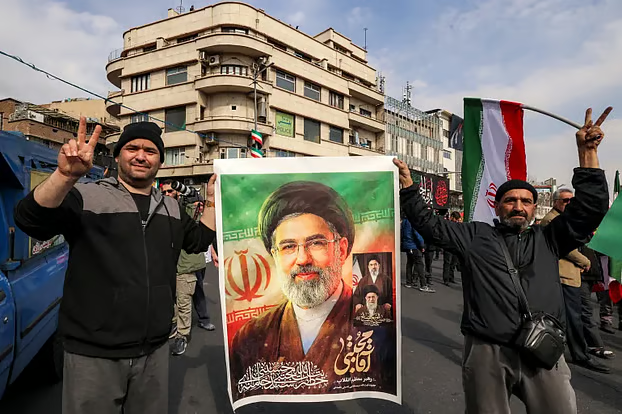
The Iranian regime has a new leader in place, and perhaps one or more leaders are already prepared to take over if Mojtaba Khamenei is killed.
So the war strategy has now reached ‘Plan B’, which has two components. The less important part is to work with minority groups like the Kurds or the Baloch to encourage their rebellion, so that the process of Iran’s collapse begins.
This may have some effect, but the Kurds, for example, will not easily trust Israel. And even less so the United States under Trump.
The second component is much more important. It is related to Israel’s traditional military strategy, which is to undermine the support of the enemy in its own country.
This is the ‘Dahiya Policy’. According to this policy, if an uprising cannot be suppressed or the leadership of a state cannot be brought to heel, then the path to victory is to continue to inflict heavy casualties on the civilian population.
This policy is currently being applied in Lebanon. There, the operation to destroy Hezbollah's stronghold in the southern Beirut suburb of Dahiya has begun. The policy was named after the area during the 2006 war against Hezbollah.
Critics say the policy has also been widely applied in the war against Hamas in Gaza over the past 30 months. At least 70,000 Palestinians have been killed, many more injured and much of Gaza reduced to rubble. Yet Hamas remains in control of parts of Gaza.

Despite this reality, the Israeli Defense Forces and the US Air Force are now applying the same policy in their war against Iran. Evidence of attacks on infrastructure is already visible.
On Tuesday, US Defense Secretary Pete Hegseth warned that this would be “our most intense day of attacks inside Iran” and that “Iran is alone on the 10th day of Operation Epic Fury and they are losing badly.”
The combination of recent Israeli military experience and a more aggressive US posture under Trump and Hegseth means we are likely to see widespread devastation across Iran.
This is a huge undertaking and it will take months to have a major impact in a country of some 93 million people, more than 40 times the population of Gaza.
Moreover, the strategy is unlikely to work.
One inevitable consequence could be an escalation of attacks by the Islamic Revolutionary Guard Corps on the oil and gas industries of the western Gulf states of the United Arab Emirates, Qatar, Kuwait and Saudi Arabia.
This could cause a shock to the global economy that could be compared to the devastating economic crisis of the 1973-74 OPEC oil embargo.
But there is still a glimmer of hope that some common sense and restraint can work. Trump’s claim that the war is almost won may be just his imagination. But there are signs that some within Israel are having second thoughts and are looking for a way out of this war. Such dissent may be slowly taking hold in Washington.
This may be cautious optimism. But it is better than the current situation, where many more weeks and months of this terrible and escalating war lie ahead.
Post a Comment